


















For cities, governments, large asset owners & facility operators

Your spatial
reasoning layer for
every asset decision.

DBF (Digital Blue Foam) is AI city-planning software that turns your spatial data into ranked scenarios — for smart cities, masterplanning, and campus, data-centre and facility decisions. Every scenario is scored on the outcomes that matter — infrastructure, ROI, liveability — and traceable to source.

Scroll to Explore

Every spatial decision gets challenged.

Where did the number come from?

Why this option? Not that one?

The plans signed today will be defended for decades.

Every unbacked answer becomes rework, delay, and a harder question next time.

The fastest movers aren't guessing — they reason over structured spatial memory and answer with an evidence chain.

Trusted By Teams Delivering Complex Projects.

Takenaka
Jacobs
McKinsey
Dubai Municipality
EGIS
15%
More compact
Smaller building footprint for the same clinical program — a major capital and operating saving.
90%
Efficiency
Faster scenario evaluation versus traditional manual workflows.
75%
Automation
Of design coordination tasks automated through integrated analytics.
Benchmarked on a healthcare facility deployment. Figures reported by DBF across client engagements.
Use cases

One engine, every spatial decision

The same reasoning layer, applied across the decisions cities, asset owners, and developers actually face. Each returns ranked scenarios with an evidence chain — never a single answer.

Aerial view of planned residential city
DBF ranked growth scenarios
Cities · Growth · Enterprise
"Where can we add 500,000 residents over 15 years without the infrastructure breaking?"
Growth plans get validated after the masterplan is locked. By then the trade-offs are concrete, not options.

A fifteen-year growth plan commits billions before anyone can see where infrastructure strains first. Onthology reasons over your city's structured memory and returns ranked spatial scenarios for where growth can land, each resolved against infrastructure load and traceable to source — in minutes, not weeks.

  1. You hold a hypothesis: the city can absorb this growth if it's placed right.
  2. DBF generates and ranks growth scenarios against performance criteria and hard constraints.
  3. You sign off on a ranked option carrying an evidence chain back to the data and rules behind it.
In paid production with Dubai Municipality and deployed as the urban intelligence platform for a 5-million-population city.
Split aerial — green suburb vs dense urban grid
DBF ranked investment scenarios
Cities · Investment · Enterprise
"Which districts return the most liveability per dirham of public investment?"
Capital gets allocated by mandate. Spatial ROI is rankable per district — most cities never measure it.

Public capital is usually allocated by mandate and precedent, not by where it returns the most liveability. Onthology scores districts on spatial ROI and ranks them, each result resolved against the city's own data and traceable to source. Allocation becomes a ranked, evidence-backed decision a council can stand behind — in minutes, not weeks.

  1. You hold a hypothesis: some districts return far more than others.
  2. DBF generates and ranks investment scenarios against performance criteria.
  3. You sign off on a ranked option with an evidence chain showing why each district places where it does.
In paid production with Dubai Municipality.
Aerial of planned city — same density, different configurations
DBF ranked density configurations
Cities · Density · Enterprise
"Same density target, three street configurations — which keeps traffic, schools and green space in balance?"
The density number is the decision. The configuration delivering it is where liveability is won or lost.

A density target is set, signed, and treated as the decision. But the same target delivered through different street and block configurations produces wildly different lived outcomes — in traffic, school access, and green space. Onthology generates ranked spatial scenarios for how to deliver it, each scored against those competing criteria and traceable to source — in minutes, not weeks.

  1. You hold a hypothesis: the density works if the configuration is right.
  2. DBF generates and ranks configurations against performance criteria and hard constraints.
  3. You sign off on a ranked option carrying its evidence chain.
Deployed as the urban intelligence platform for a 5-million-population city.
City density gradient aerial
DBF gap analysis scenarios
Cities · Gap Analysis · Enterprise
"Which underserved districts can sustain new commercial amenity — and where is demand going unmet?"
Investment chases proven areas. The opportunity is the starved catchment, not the crowded one — and it's measurable.

Commercial investment concentrates where demand is already proven, which means the underserved catchment stays invisible and unbuilt. Onthology reasons over population, access, existing provision, and movement to surface those gaps, returning ranked scenarios for where new amenity is supportable, each traceable to source — in minutes, not weeks.

  1. You hold a hypothesis: some underserved districts can carry amenity others can't.
  2. DBF generates and ranks candidate districts against performance criteria and hard constraints.
  3. You sign off on a ranked option with an evidence chain back to the signals behind it.
Deployed as the urban intelligence platform for a 5-million-population city, with gap-analysis capability in production.
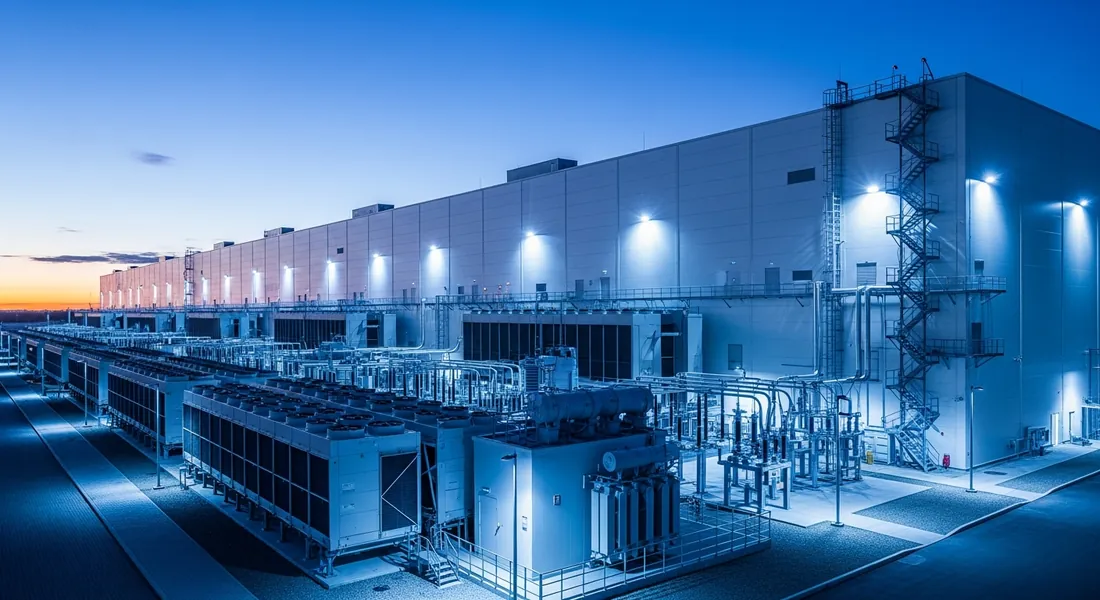
Data centre at night — power, cooling and access constraints
DBF ranked data centre layout scenarios
Data Centres · Enterprise
"Can this site take a 40,000 m² data centre within power, cooling and access limits?"
Capacity questions get a yes/no. The real answer is a ranked set of layouts that clear every hard constraint.

A site-capacity question usually comes back as a single yes or no — which hides the more useful answer. The real output is the set of layouts that actually clear every hard constraint: power, cooling, access, setbacks. Onthology returns ranked spatial scenarios that satisfy each constraint, every option traceable to source — in minutes, not weeks.

  1. You hold a hypothesis: this site can carry the facility.
  2. DBF generates and ranks layout scenarios against hard constraints and performance criteria.
  3. You sign off on a ranked option with an evidence chain back to the constraints it clears.
In paid production on MODON industrial deployments.
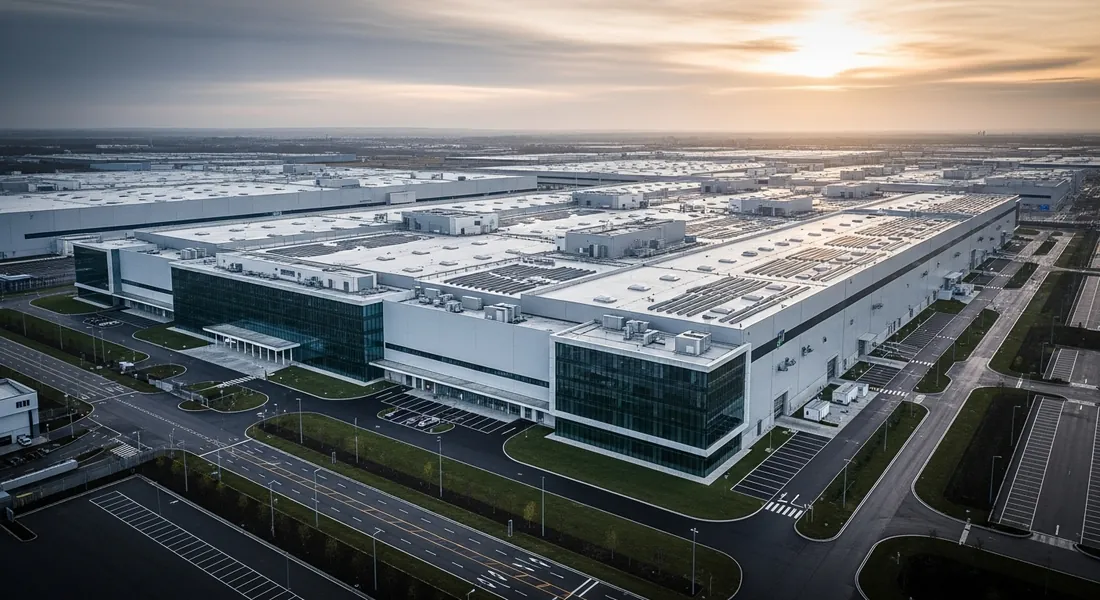
EV manufacturing plant aerial
DBF ranked EV plant layout scenarios
EV / Battery · Enterprise
"We're siting a new EV plant — can this parcel carry the power and process load, and what layout delivers it?"
Power capacity is checked late, as an engineering input. It's a layout constraint that decides the whole footprint.

Power and process load are usually checked late, treated as engineering inputs after the layout is sketched. But on an EV or battery plant they're the constraint that decides the entire footprint — checked late, they force expensive rework. Onthology treats power and process load as primary spatial constraints from the start, returning ranked scenarios that carry the load, each traceable to source — in minutes, not weeks.

  1. You hold a hypothesis: this parcel can carry the plant.
  2. DBF generates and ranks layout scenarios against hard constraints and performance criteria.
  3. You sign off on a ranked option with its evidence chain.
In paid production across the MODON industrial pipeline.
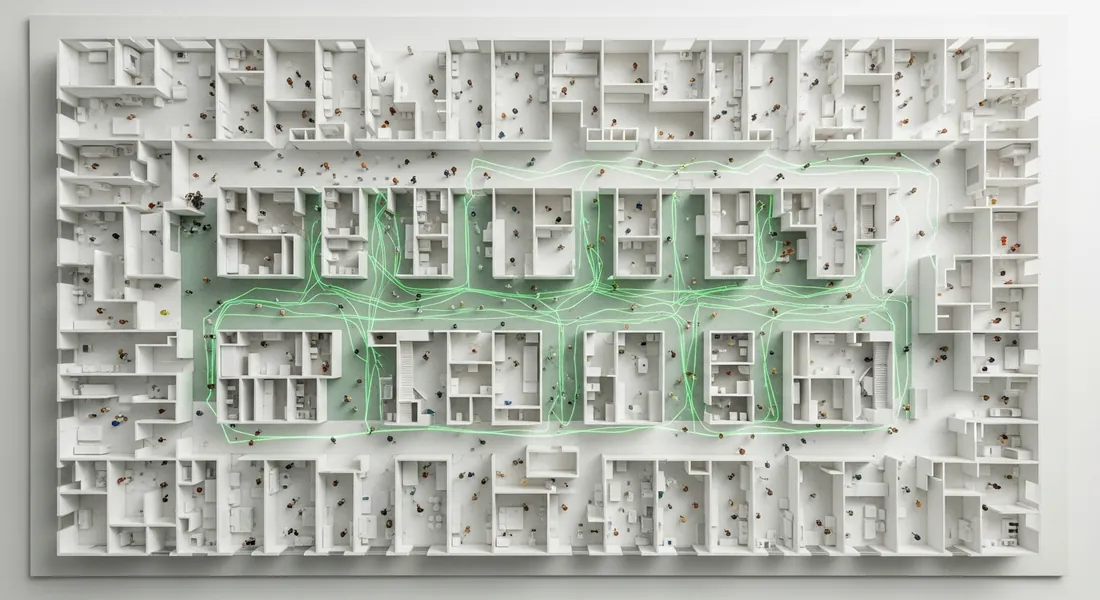
Hospital corridor — every extra step staff take, every shift, for decades
DBF hospital layout model — optimal routing paths
Healthcare · Enterprise
"Which department layout cuts the distance staff and patients travel each shift — without breaking clinical adjacency rules?"
Hospital layout is treated as an architectural decision. It's an operational one — paid for in staff steps, every shift, for decades.

A hospital's department layout is usually settled as an architectural decision, then lived with operationally for decades — paid for in every extra step staff and patients take, every shift. Onthology treats layout as the operational decision it is, generating ranked scenarios that cut travel distance while holding every clinical adjacency rule, each option traceable to source — in minutes, not weeks.

  1. You hold a hypothesis: a better layout exists that respects the clinical rules.
  2. DBF generates and ranks layouts against hard constraints and performance criteria.
  3. You sign off on a ranked option carrying its evidence chain.
In paid production with Jacobs, with computational layout validated against expert specialists in peer-reviewed research (Lather 2020; Boonme 2022).
Japanese residential neighbourhood
Hikari ranked unit-yield scenarios
Japan · Unit Yield · Hikari
"How many units fit this site once FAR, setback and shadow regulations are all applied at once?"
The buildable envelope isn't FAR × area. It's FAR, setback and shadow law solving against each other — which is why the by-hand answer is always conservative.

The buildable envelope gets estimated as floor-area ratio times site area, then trimmed by hand for setback and shadow rules — and the by-hand answer is always conservative, leaving units on the table. Hikari solves FAR, setback, and shadow regulation against each other at once, returning ranked scenarios for how many units actually fit, each traceable to the regulation behind it — in minutes, not weeks.

  1. You hold a hypothesis: the site carries more units than the by-hand number suggests.
  2. Hikari generates and ranks unit configurations against hard constraints.
  3. You sign off on a ranked option with an evidence chain back to each rule it satisfies.
Built with Takenaka as a paid customer, with trials underway with four of Japan's top-five contractors.
How it works

Ask a real spatial question
Get a defensible answer

DBF pairs scenario generation with spatial analytics: it generates and ranks scenarios, then scores each one against your hard constraints and the outcomes that matter. Every step is traceable. The answer arrives with its reasoning attached — ready for approval, governance, and capital. Minutes, not weeks.

"Where can we add 500 homes without overloading
infrastructure or reducing access to parks?"
Aerial view — residential city with school and park, the spatial question DBF reasons over
Intent
Spatial Retrieval
Constraint Resolution
Generative Scenarios
Criteria Scoring
Evidence Package
Why DBF

Anyone can call an LLM
The spatial memory beneath it is the moat

DBF doesn't guess at your city or asset. It reasons over a structured memory of the real one — and every answer carries its evidence.

/01

Structured spatial memory

Every parcel, rule, metric, and relationship is encoded once as a queryable model — not loose documents. Competitors start from a blank prompt. DBF starts from your full context.

/02

Reasoning over entities, not text

Answers are generated from explicit parcels, rules, geometries, and relationships — not language-model guesswork. That removes hallucination and makes every recommendation defensible.

/03

Every answer carries an evidence chain

Each recommendation traces back to where it came from — fit for approvals, governance, and capital.

Decision metric relationship entity geometry source
Spatial analytics platform showing ranked scenario outcomes
Bring evidence to the decisions that shape a place

One reasoning Any scale

Most spatial tools optimise for what's easy to count — floor area, yield, cost. DBF reasons across those too, but it doesn't stop there. It asks the same question of a neighbourhood and of a single building: does this place work for the people in it? Zoom all the way out, or all the way in — it's the same engine, scoring the same human outcomes.

City scale How a neighbourhood lives Does it work for the people who live there?
Facility scale How an asset performs Does it work for the people who run and use it?
City block zooming into building floor plan — one reasoning engine at any scale
City outcomes
Walkability Access to parks Neighbourhood quality
Always counted · shared
Infrastructure Spatial ROI Cost Capacity
Facility outcomes
Staff travel Throughput Adjacency Operational efficiency
City outcomes Facility outcomes Shared — always counted

One engine, scored end to end — from the hard numbers every decision counts, to the human outcomes most tools ignore. Proven across cities, data centres, plants and hospitals.

Products

One reasoning engine
Three ways to put it to work

A single spatial reasoning engine, delivered three ways — from full-stack enterprise deployment to a self-serve planner.
Whatever the surface, every answer is a ranked scenario traceable to source.

Enterprise — spatial analytics platform
Enterprise · Proven
Enterprise

Full-stack custom deployment for cities, governments, large asset owners, and facility operators. Your proprietary data, the complete platform — encoding your spatial memory and scoring every scenario against the outcomes that matter. In paid production with Dubai Municipality, MODON, Jacobs and more.

Cities · governments · asset owners · facility operators
Talk to Sales
Onthology — the spatial reasoning engine
Onthology · In build
Onthology

The spatial reasoning engine behind every DBF deployment — encoding a structured model of a city or asset and generating ranked scenarios with an evidence chain. Delivered today through Enterprise; becoming a self-serve product in its own right.

The reasoning engine · self-serve coming
Request Early Access
Hikari — Japan self-serve unit-yield scenarios
Self-serve · Japan
Hikari

Self-serve planning for developers and planners in Japan. Resolve FAR, setback, and shadow regulations together and return ranked unit-yield scenarios in minutes — traceable to the regulation behind each one.

Developers · planners · Japan
Per seat / month
Go to Hikari

Planning a data centre, EV plant, hospital, or other complex facility? DBF Enterprise deploys for large asset owners and facility operators — start with a demo →

Get started

See DBF reason over
a real site and brief

In a short demo, you'll ask a real question, watch ranked scenarios resolve against your data, and walk through the evidence behind every answer.

SOC 2 & ISO 27001 certified · On-prem or hybrid deployment

Learn more

Read the platform whitepaper

A deep-dive into the DBF reasoning engine, the structured spatial memory architecture, and the evidence-chain model that makes every answer defensible.

Read Platform Brief